
Where to Start with AI in Ecommerce: A 90-Day Roadmap

It's a Sprint, Not a Moonshot
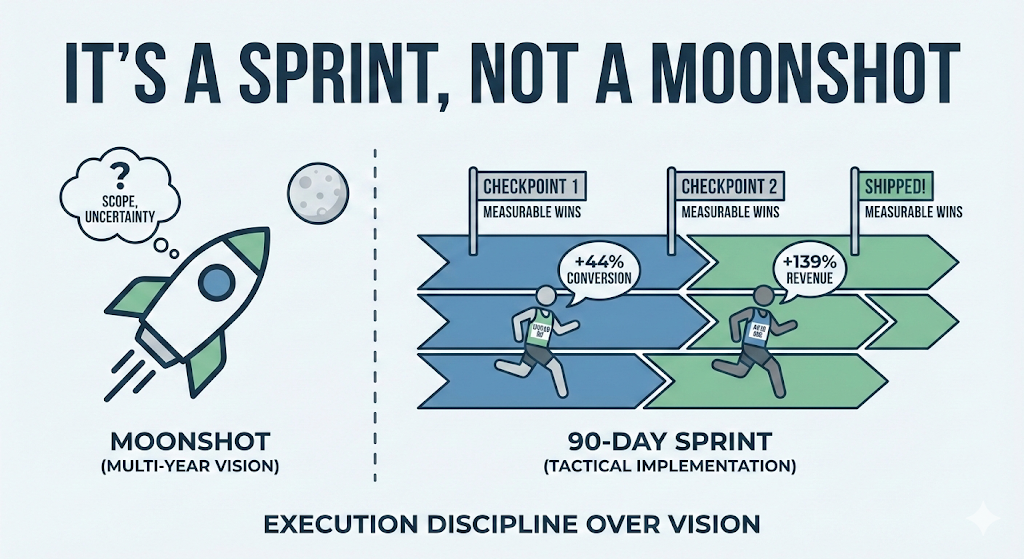
Most retailers treat AI like a moonshot. It's actually a 90-day sprint with measurable checkpoints.
The gap between "we should do AI" and "we shipped AI" isn't vision. It's execution discipline.
Mid-market retailers are paralyzed by scope, budget uncertainty, and the assumption that AI requires a multi-year transformation. Meanwhile, competitors are shipping pilots, learning from real data, and compounding wins every quarter.
United RV saw a 44% conversion lift from cleaning product feeds. Auto One drove 139% organic revenue growth with real-time catalog updates.
These weren't AI research projects. They were tactical implementations with clear success metrics, tight timelines, and cross-functional ownership.
Start with the Boring Work
AI doesn't fail because the models are weak. It fails because product data is incomplete, taxonomies are inconsistent, and nobody owns the feedback loop between what the AI recommends and what actually converts.
You can't personalize recommendations if half your SKUs are missing size attributes. You can't deploy a chatbot if your knowledge base is scattered across Notion, Zendesk, and outdated PDFs.
The teams winning in 90 days spend the first month fixing infrastructure, not chasing shiny features.
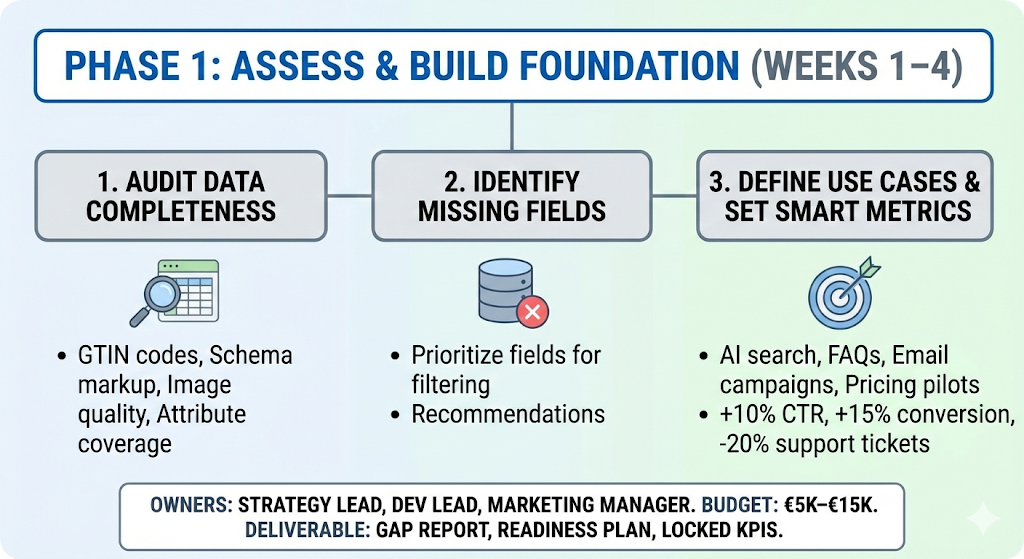
Phase 1: Assess and Build Foundation (Weeks 1–4)
This is where most roadmaps fail. Teams skip data audits and jump straight to vendor demos. Then they hit Week 6 and realize their catalog isn't AI-ready.
What to do:
Audit product data completeness: GTIN codes, schema markup, image quality, attribute coverage.
Identify missing fields and prioritize the ones that drive filtering and recommendations.
Define specific use cases with clear ROI: AI-powered search, on-site assistant for FAQs, personalized email campaigns, dynamic pricing pilots.
Set SMART metrics before writing code. Not "improve engagement." Specifics: +10% CTR on search results, +15% email conversion, 20% reduction in support tickets.
Owners: Strategy lead, dev lead, marketing manager
Budget: €5K to €15K
Deliverable: Gap report, prioritized use cases, data readiness plan, locked KPIs
Phase 2: Pilot and Optimize (Weeks 5–8)
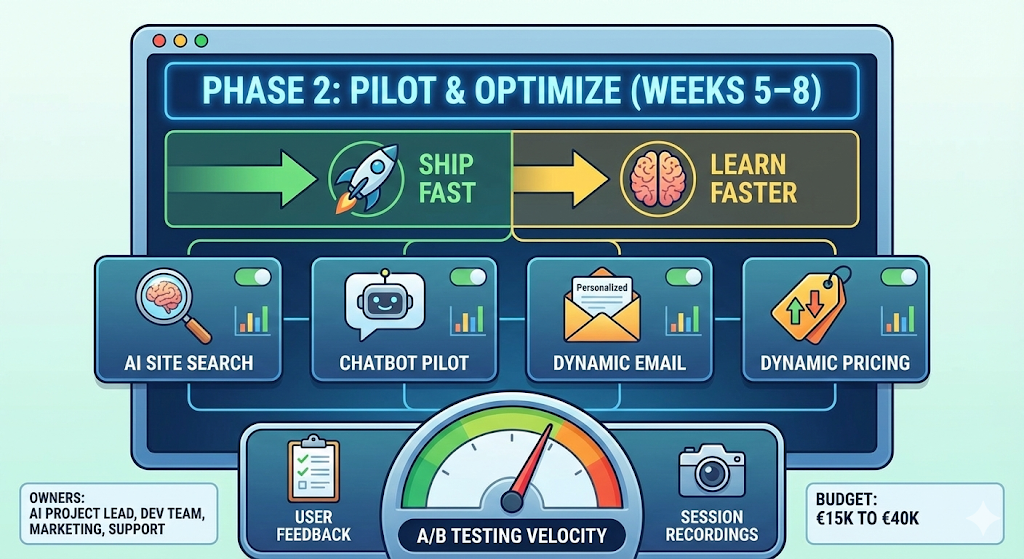
Ship fast. Learn faster.
What to deploy:
AI-powered site search with semantic and visual capabilities.
Chatbot pilot handling FAQs and simple order tracking.
Dynamic email personalization with product recommendations based on browse and purchase history.
Dynamic pricing with strict guardrails: price floors, rate limits, human approval for large swings.
Run A/B tests on every feature. Measure everything. Collect user feedback through surveys and session recordings.
This is the phase where you learn what actually moves the needle versus what looked good in the pitch deck.
Owners: AI project lead, dev team, marketing, customer support
Budget: €15K to €40K
Deliverable: Working search, chatbot, email campaigns live, pricing pilot data, feedback reports
Phase 3: Scale and Deepen (Weeks 9–12)
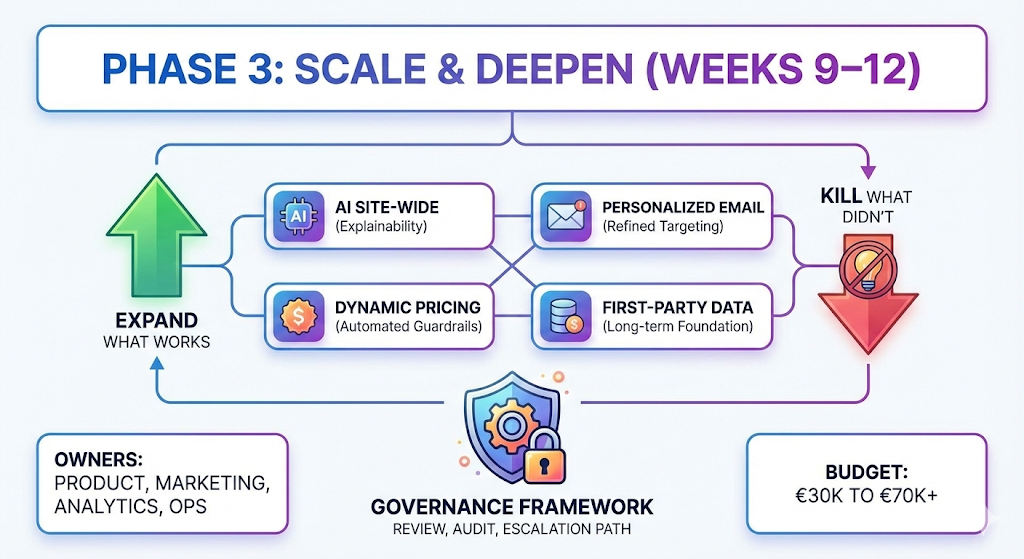
Take what worked and scale it. Kill what didn't.
What to expand:
AI search and assistants site-wide with explainability features showing users why they're seeing recommendations.
Personalized email volume with refined targeting models.
Dynamic pricing with automated guardrails and continuous monitoring.
First-party data foundations for long-term personalization.
Establish a governance framework: Who reviews AI outputs? How often do you audit for drift? What's the escalation path when something breaks?
Owners: Product, marketing, analytics, ops
Budget: €30K to €70K+
Deliverable: Full deployment, ROI analysis, ongoing governance plan
Minimum Viable Success
What good looks like:
- +10% conversion from AI search and recommendations
- +10 to 20% email CTR and conversion improvement
- 15 to 25% reduction in support tickets
- Stable pricing with no adverse customer impact
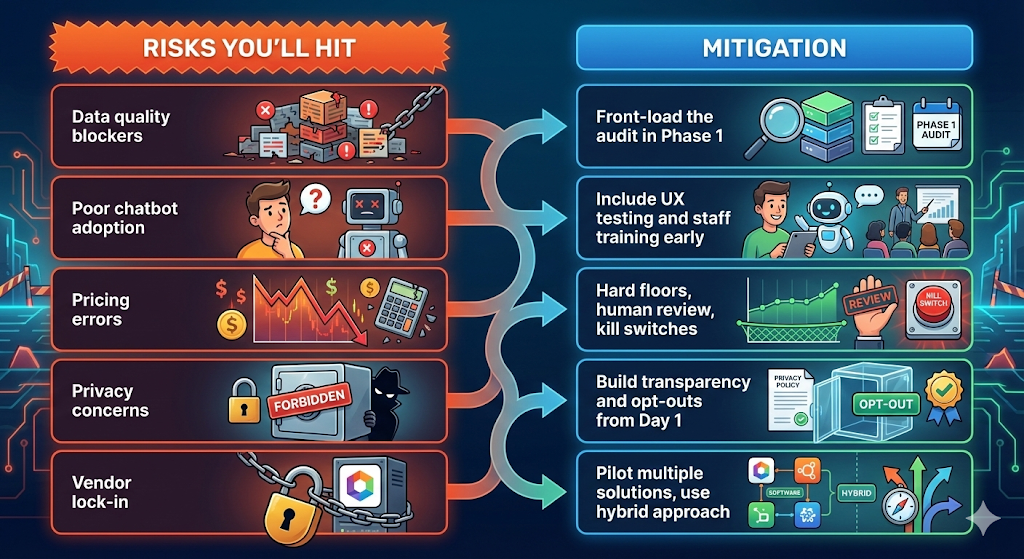
Risks You'll Hit
Risk
Mitigation
Data quality blockers
Front-load the audit in Phase 1
Poor chatbot adoption
Include UX testing and staff training early
Pricing errors
Hard floors, human review, kill switches
Privacy concerns
Build transparency and opt-outs from Day 1
Vendor lock-in
Pilot multiple solutions, use hybrid approach
The Uncomfortable Truth
Most AI projects fail in Month 4, not Month 1.
Teams ship fast, celebrate early wins, then fail to build the operational muscle for continuous improvement. The chatbot starts giving bad answers. The pricing model drifts. Nobody owns the metrics anymore.
The retailers who succeed treat AI like production infrastructure, not a marketing campaign. They assign owners. They monitor weekly. They iterate ruthlessly.
You don't need a data science team to start. You need clean product data, clear metrics, and someone who owns the outcome.
The vendors will handle the models. Your job is to make sure the inputs are right and the outputs are measured.
Start Shipping
Ninety days. Three phases. Measurable wins at each checkpoint.
If you can't ship something useful in that timeframe, you're solving the wrong problem or building the wrong team.
Stop planning. Start shipping.

.png)
.png)