
Product Catalog Enrichment: The Foundation of AI-Readable Commerce

Static Catalogs Are Incompatible with AI Commerce
Product catalog enrichment is the process of transforming raw product listings into structured, AI-readable datasets that power discovery, personalization, and agent-driven recommendations.
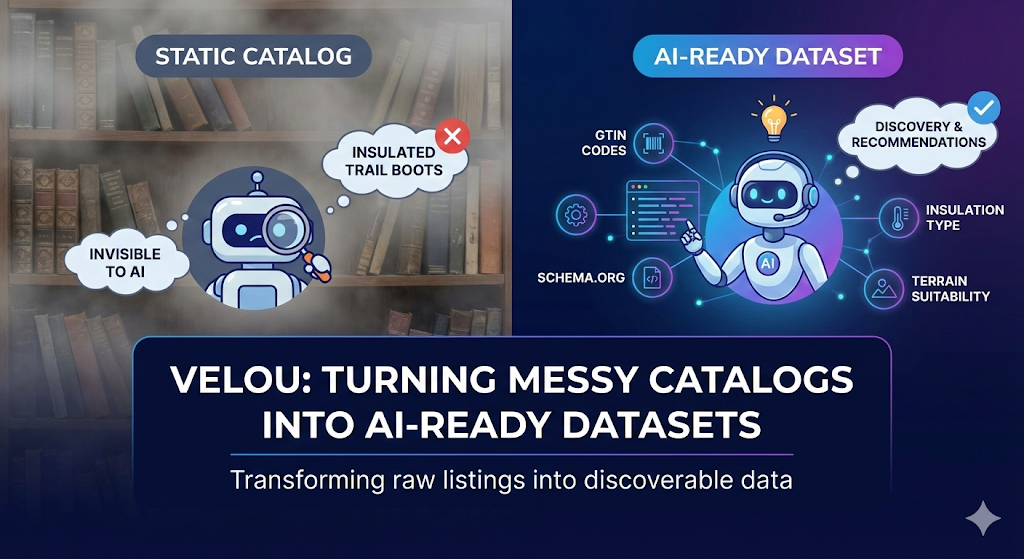
In the era of AI shopping assistants and conversational commerce, a static catalog with basic titles and descriptions isn't just outdated. It's invisible.
When someone asks ChatGPT or Rufus to recommend "insulated trail boots for hiking," the AI doesn't browse product pages. It queries structured data: GTIN codes, schema.org markup, granular attributes like insulation type, terrain suitability, and ankle height.
If your catalog lacks this depth, you're not in the consideration set.
At Velou, we help retailers turn messy, incomplete catalogs into AI-ready datasets that surface in agent recommendations, visual search, and voice commerce.
Static Catalogs Are Incompatible with AI Commerce
Product catalog enrichment is the process of transforming raw product listings into structured, AI-readable datasets that power discovery, personalization, and agent-driven recommendations.
In the era of AI shopping assistants and conversational commerce, a static catalog with basic titles and descriptions isn't just outdated. It's invisible.
When someone asks ChatGPT or Rufus to recommend "insulated trail boots for hiking," the AI doesn't browse product pages. It queries structured data: GTIN codes, schema.org markup, granular attributes like insulation type, terrain suitability, and ankle height.
If your catalog lacks this depth, you're not in the consideration set.
At Velou, we help retailers turn messy, incomplete catalogs into AI-ready datasets that surface in agent recommendations, visual search, and voice commerce.
Static Catalogs Are Incompatible with AI Commerce
Product catalog enrichment is the process of transforming raw product listings into structured, AI-readable datasets that power discovery, personalization, and agent-driven recommendations.
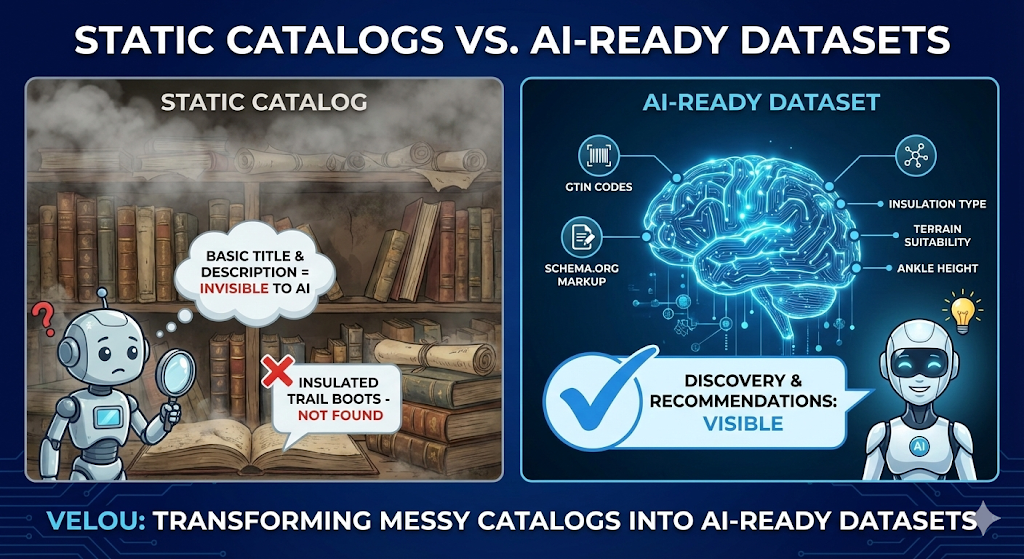
In the era of AI shopping assistants and conversational commerce, a static catalog with basic titles and descriptions isn't just outdated. It's invisible.
When someone asks ChatGPT or Rufus to recommend "insulated trail boots for hiking," the AI doesn't browse product pages. It queries structured data: GTIN codes, schema.org markup, granular attributes like insulation type, terrain suitability, and ankle height.
If your catalog lacks this depth, you're not in the consideration set.
At Velou, we help retailers turn messy, incomplete catalogs into AI-ready datasets that surface in agent recommendations, visual search, and voice commerce.
What Is Product Catalog Enrichment?
Enrichment means augmenting product data with structured attributes, metadata, and universal identifiers that make catalogs searchable and actionable for AI systems.
The core components:
GTIN/UPC/EAN codes from GS1 for universal product identification. Without these, platforms like Amazon suppress listings and agents can't reliably match products across queries.
Schema.org/Product markup that validates across Google, OpenAI, and other agent platforms. This is how AI systems parse product details, pricing, availability, and reviews.
Granular attributes like size, color, material, fit, use case, and benefits. These fields drive filtering, matching, and contextual recommendations.
High-quality images with descriptive alt text that enable visual search and multimodal agents to identify and recommend products accurately.
Structured review and rating data that AI agents use to assess trust and quality when making recommendations.
Modern enrichment uses AI to automate this at scale: extracting details from images, generating descriptions, standardizing taxonomies, and ensuring consistency across channels.
Why AI Requires Enriched Catalogs
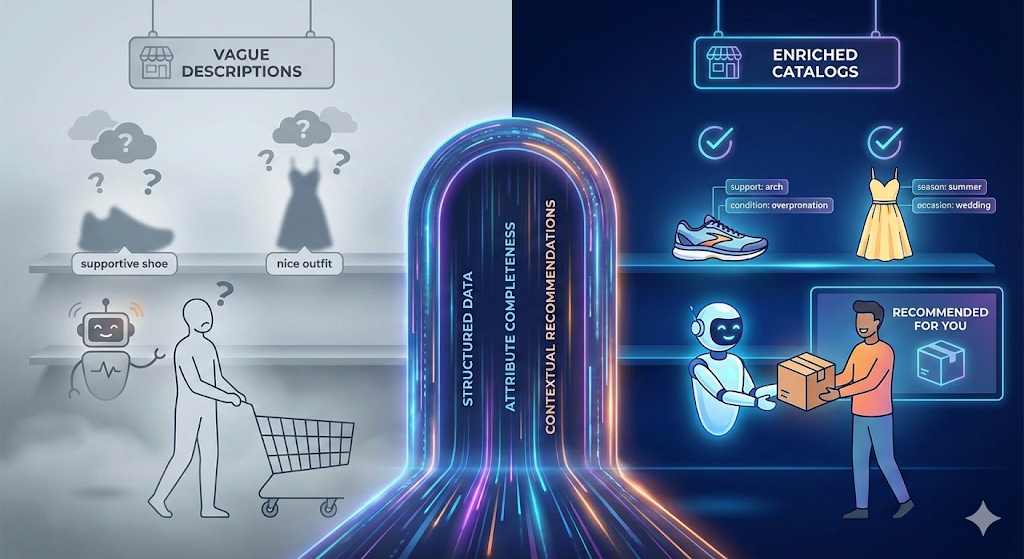
AI shopping assistants don't interpret vague descriptions or marketing copy. They match structured data to queries.
When a customer asks for "running shoes with arch support for overpronation," the agent needs structured fields like support_type: arch and condition_addressed: overpronation. A description that says "supportive and comfortable" doesn't help.
The visibility gap:
Retailers with 95% attribute completeness surface in agent recommendations. Those with 60% completeness are functionally invisible for queries requiring missing fields.
AI systems penalize incomplete data because they optimize for confident matches. If they can't verify that your product meets the query requirements, they recommend a competitor instead.
The personalization requirement:
Enriched catalogs enable contextual recommendations. AI agents layer location, purchase history, and intent signals onto structured product data to deliver "show me dresses for a summer wedding" or "insulated boots available near me today."
Without rich attributes, personalization collapses to price sorting.
Common Catalog Problems
Most retail catalogs suffer from predictable gaps that kill AI discoverability.
Missing or incomplete attributes.
Size, color, material, and use case fields are often absent or inconsistent. Every missing field reduces the queries your products can match.
No universal identifiers.
Products without GTIN/UPC codes can't be reliably tracked across platforms. Amazon and Google Shopping suppress listings without valid GTINs.
Duplicate or conflicting data.
The same product categorized differently across channels confuses agents and creates filtering errors.
Poor variant mapping.
AI agents can't distinguish between sizes, colors, or pack quantities if variant relationships aren't explicitly defined.
Generic or missing image alt text.
Visual search and multimodal agents rely on descriptive alt text. Generic text like "product image" renders products invisible in visual queries.
Lack of schema.org markup.
Without structured data validation, agent platforms treat your catalog as low-confidence unstructured content.
The Velou Approach: AI-Powered Enrichment Workflow
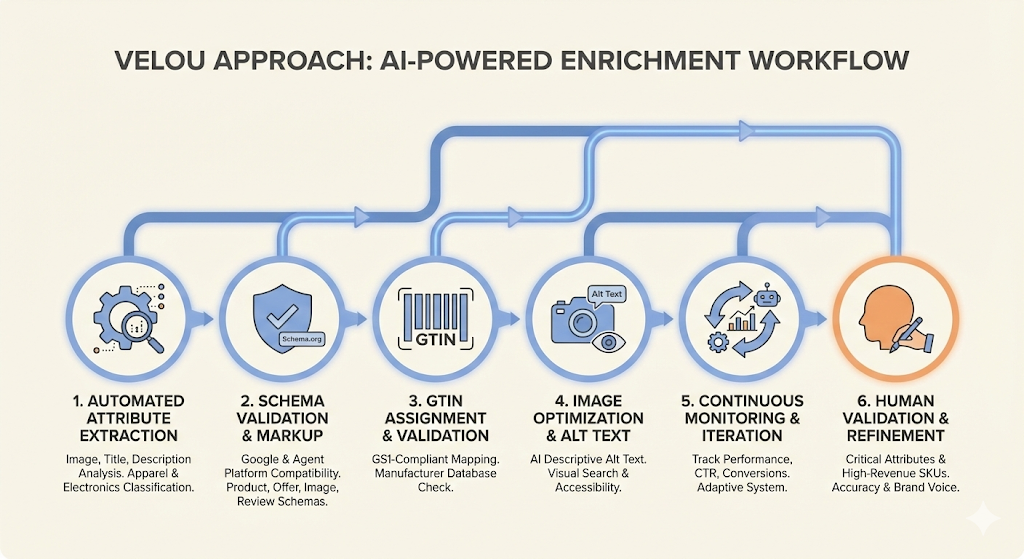
Velou uses multimodal AI to enrich catalogs at scale while maintaining human-in-the-loop quality control.
Step 1: Automated attribute extraction.
AI analyzes product images, titles, and descriptions to extract structured attributes. Apparel gets classified by style, fit, and fabric. Electronics get specs, compatibility, and features.
Step 2: Schema validation and markup.
We generate and validate schema.org/Product markup ensuring compatibility with Google, OpenAI, and agent platforms. This includes product, offer, image, and review schemas.
Step 3: GTIN assignment and validation.
We map products to GS1-compliant GTIN codes, validate against manufacturer databases, and ensure universal identification.
Step 4: Image optimization and alt text generation.
AI generates unique, descriptive alt text for each image optimized for visual search and accessibility. Multiple images per SKU with category-specific descriptions.
Step 5: Continuous monitoring and iteration.
We track how enriched products perform in agent recommendations, CTR, and conversions. The system adapts based on what's working.
Step 6: Human validation and refinement.
Critical attributes and high-revenue SKUs get human review to ensure accuracy and brand voice alignment.
GEO and AEO Integration
Enriched catalogs are foundational for Generative Engine Optimization (GEO) and AI Engine Optimization (AEO).
GEO focuses on surfacing in AI-generated answers. When ChatGPT or Perplexity generates shopping recommendations, they pull from catalogs with rich structured data, verified identifiers, and authoritative metadata.
AEO optimizes for agent-driven discovery. Amazon Rufus, Google Shopping Assistant, and similar platforms prioritize products with complete attributes, real-time inventory, and schema-compliant markup.
Velou ensures your catalog meets the technical requirements for both: structured data that validates, real-time feeds that agents trust, and attribute depth that enables confident matching.
Business Outcomes: Visibility, Conversion, Reduced Returns
Retailers using enriched catalogs see measurable improvements across the funnel.
Higher visibility in agent recommendations.
Products with complete attributes surface 3 to 5x more often in AI shopping assistant queries compared to incomplete listings.
Increased CTR and conversion.
Structured data enables better matching, which drives higher click-through and conversion rates. A/B tests show 10 to 25% lifts from enrichment alone.
Reduced return rates.
Accurate, detailed product information reduces purchase mismatches. Customers get what they expect, leading to fewer returns and higher satisfaction.
Improved personalization.
Rich attributes enable contextual recommendations that adapt to location, intent, and preferences, driving higher AOV and repeat purchase rates.
Platform compliance.
Amazon, Google Shopping, and other marketplaces increasingly require GTIN codes and structured data. Enrichment prevents suppression and penalties.
The Future: Catalogs as Knowledge Graphs
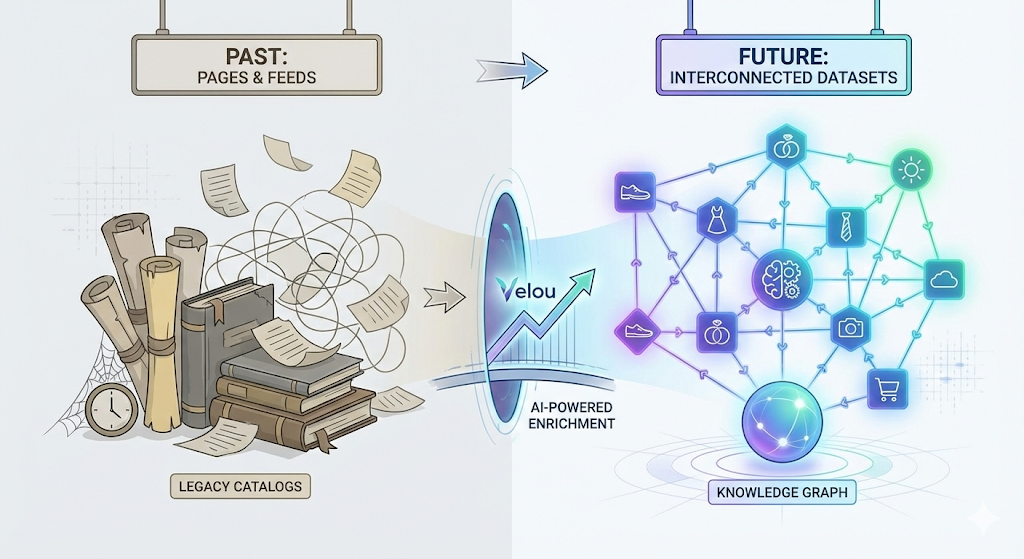
The next evolution of product catalogs isn't pages or feeds. It's knowledge graphs.
Knowledge graphs connect products through relationships: variants, accessories, bundles, complementary items, use cases, and contexts. They enable agents to answer complex queries like "show me outfits for an outdoor wedding" by traversing relationships and delivering multi-product recommendations.
Velou is building toward this future by structuring catalogs not just as lists of products, but as interconnected datasets that AI agents can query, traverse, and reason over.
The retailers who invest in enrichment now are building the foundation for knowledge graph commerce. Those who wait will be stuck with legacy catalogs that can't compete in agent-driven discovery.
Start Enriching Today
Your catalog is either AI-ready or it's invisible.
Velou transforms messy, incomplete product data into structured, agent-compatible datasets that surface in recommendations, visual search, and voice commerce.
The technical lift is real, but the ROI is immediate: higher visibility, better conversion, lower returns, and compliance with platform requirements.
If your catalog isn't enriched, you're competing in an AI commerce landscape with a handicap you can't overcome.
Contact Velou to audit your catalog and build your enrichment roadmap.

.png)
.png)