
Product Attribute Enrichment: Powering Discoverability and Personalization at Scale

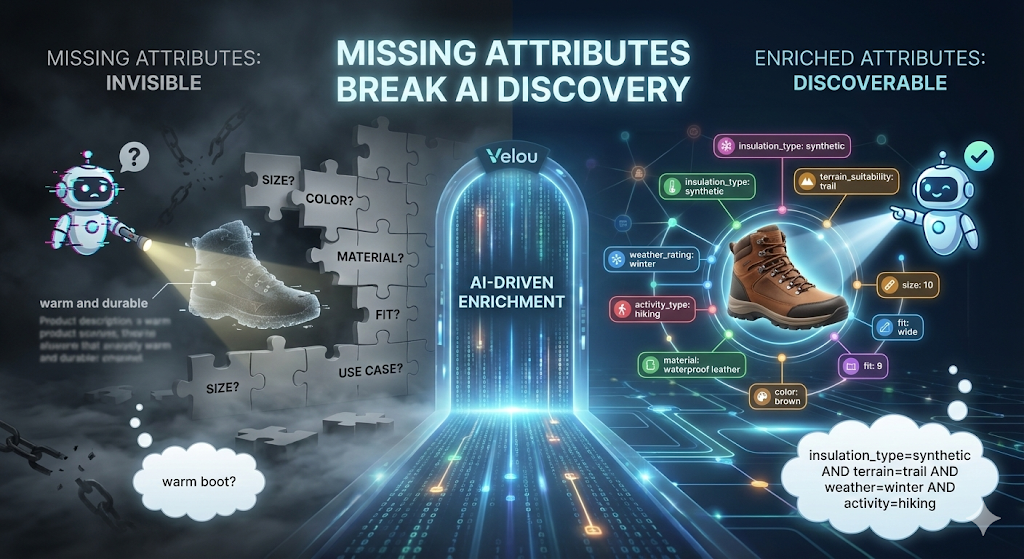
Missing Attributes Break AI Discovery
Product attribute enrichment is the process of automatically generating, standardizing, and augmenting product details—size, color, material, fit, use case—to enable AI-powered discovery and personalization.
Without rich, structured attributes, your products are invisible to AI shopping assistants, visual search, and recommendation engines.
When someone asks an AI agent for "insulated trail boots for winter hiking," the system queries structured attributes: insulation_type, terrain_suitability, weather_rating, activity_type. A product description that says "warm and durable" doesn't help.
The gap isn't that retailers lack good products. It's that their product data lacks the granularity AI systems require to match queries confidently.
At Velou, we use AI-driven extraction, normalization, and validation to transform incomplete catalogs into structured datasets that power discovery at scale.
What Is Product Attribute Enrichment?
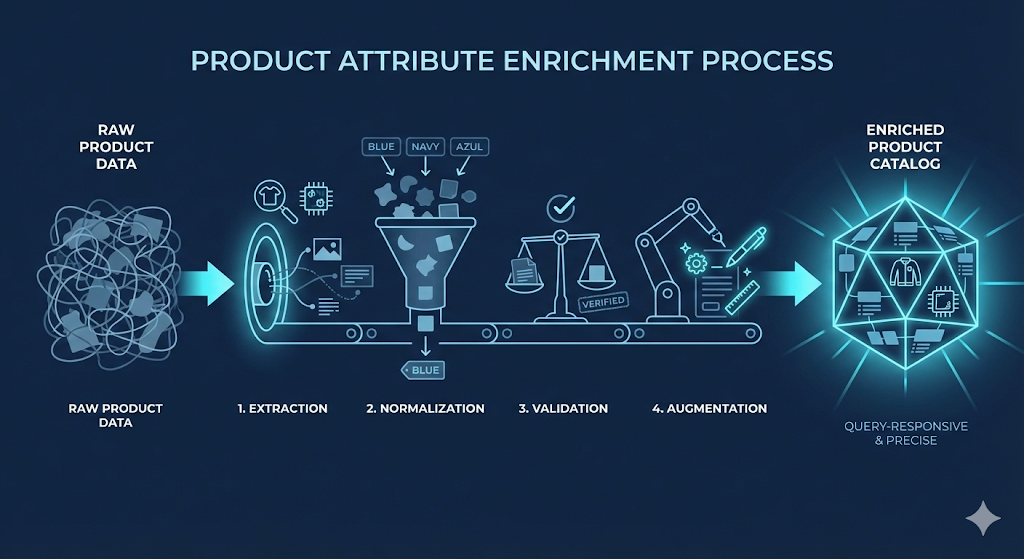
Attribute enrichment systematically improves raw product data through AI-driven extraction from text, images, and descriptions, followed by normalization and validation.
The process:
Extraction. AI analyzes product images, titles, and descriptions to identify explicit and implicit attributes. Apparel gets classified by silhouette, fabric, fit, and occasion. Electronics get specs, compatibility, and feature sets.
Normalization. Inconsistent values like "Blue," "Navy," and "Azul" get standardized to a single taxonomy. This ensures filters work correctly and agents can match queries reliably.
Validation. Extracted attributes are validated against category standards, manufacturer data, and behavioral signals to ensure accuracy.
Augmentation. Missing attributes are generated based on category norms, visual analysis, and similar product patterns.
Modern enrichment fuses generative AI, machine vision, and behavioral data to create precise, query-responsive product catalogs.
Why Missing Attributes Kill Discoverability
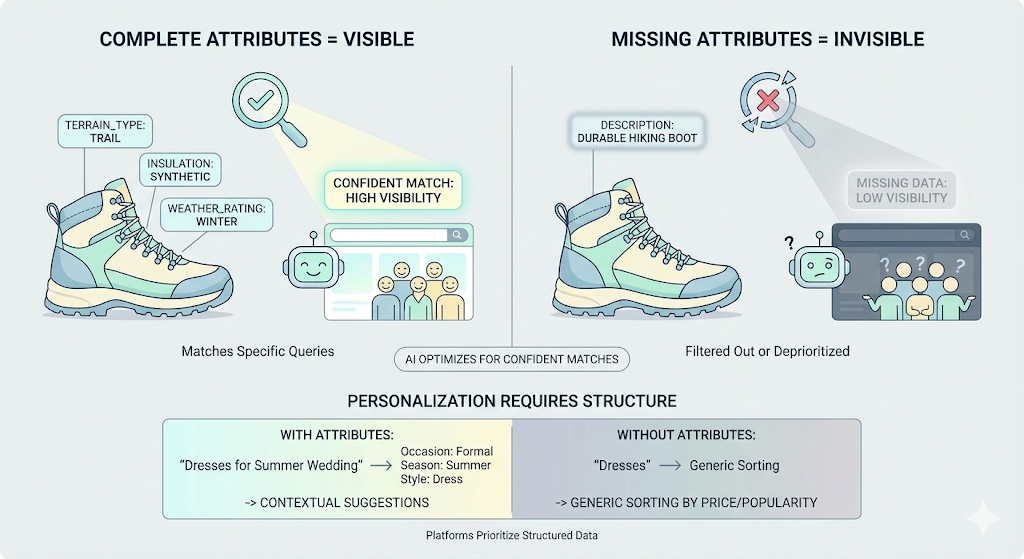
AI systems optimize for confident matches. If your product lacks the attributes required by a query, it won't surface—even if it's the best match by other criteria.
The visibility math:
A hiking boot with terrain_type: trail, insulation: synthetic, and weather_rating: winter surfaces for queries like "insulated trail boots for cold weather."
The same boot with only a generic description "durable hiking boots" is invisible for that query.
Every missing attribute reduces the number of queries your product can match. A catalog with 60% attribute completeness isn't 60% as effective—it's functionally incomplete for most specific queries.
The personalization requirement:
AI recommendation engines use attributes to power contextual suggestions. "Show me dresses for a summer wedding" requires attributes like occasion: formal, season: summer, and style: dress.
Without these fields, personalization collapses to generic sorting by popularity or price.
Platforms like Amazon, Google Shopping, and conversational agents prioritize products with complete, structured attributes in their ranking algorithms. Incomplete data gets deprioritized or filtered out entirely.
The Normalization Challenge
Most retailers struggle with attribute inconsistency, not just missing data.
Common problems:
Multi-vendor data chaos. Different suppliers describe the same attribute differently: "Blue" vs. "Navy" vs. "Bleu" vs. "Azul." Without normalization, filters break and queries fail.
Varying formats. Dimensions might be "10 x 5 x 3 inches" or "10in x 5in x 3in" or "25.4 x 12.7 x 7.6 cm." AI agents need consistent units and formats to compare products.
Missing taxonomies. Products categorized inconsistently across channels confuse agents and create filtering errors. "Athletic Footwear" vs. "Sports Shoes" vs. "Running Gear" should map to a single standard.
Multilingual issues. Global catalogs require attributes in multiple languages with consistent meaning across translations.
Manual normalization creates bottlenecks and doesn't scale. As marketplace requirements change and new categories launch, the normalization workload compounds.
Poor normalization leads to frustrating UX: unfilterable categories, unreliable comparisons, and queries that return irrelevant results.
AI Extraction Models That Work
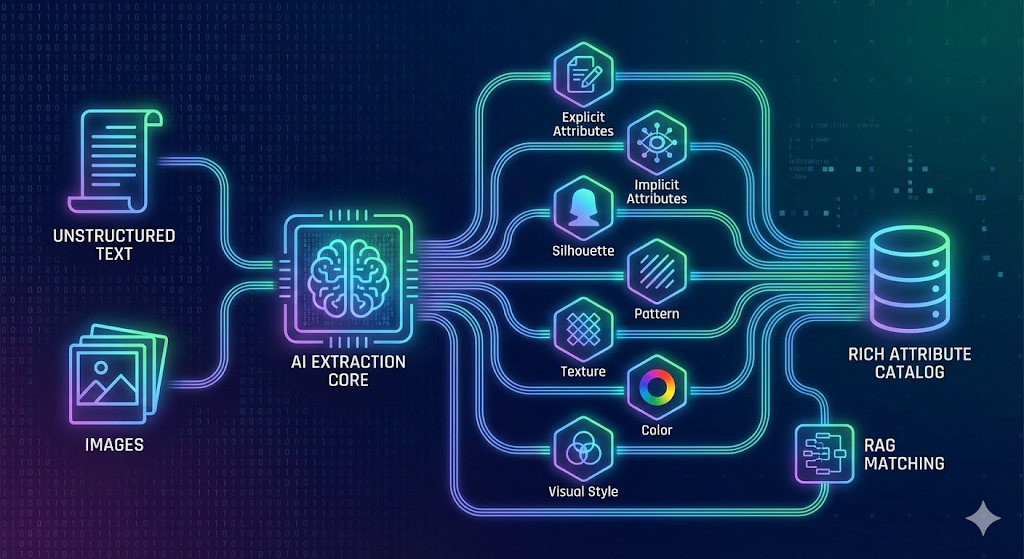
Generative AI models excel at extracting attributes from unstructured text and images.
Text extraction. Large language models analyze product titles, descriptions, and specifications to identify explicit attributes (stated directly) and implicit attributes (inferred from context). They achieve F1-scores above 92% on benchmark datasets.
Image extraction. Computer vision models derive attributes from product images: silhouette, pattern, texture, color palette, and visual style. For apparel, this might include neckline type, sleeve length, and fit. For furniture, dimensions, material, and assembly type.
Multimodal fusion. Combining text and image signals produces more accurate and complete attribute sets than either modality alone. If the description says "waterproof" but the image shows mesh panels, the model flags the inconsistency.
RAG for catalog matching. Retrieval-Augmented Generation pulls attribute patterns from similar products to infer missing fields. If 95% of "trail running shoes" have terrain_type: mixed and cushioning: moderate, the system suggests these for products missing those attributes.
These techniques outperform traditional rule-based tagging in data efficiency, multilingual support, and handling of ambiguous or incomplete inputs.
How Platforms Use Attributes for Ranking and Personalization
E-commerce platforms and AI agents prioritize products with rich, accurate attributes in their ranking algorithms.
Behavioral signals. Click-through rate, conversion rate, and add-to-cart activity for specific attribute combinations inform future rankings. A product with high CTR for "waterproof trail shoes" gets boosted for similar queries.
Affinity dimensions. Category, brand, visual style, and price range attributes power affinity-based recommendations. "Customers who bought X also liked Y" relies on shared attribute patterns.
Dynamic weighting. Platforms adjust attribute importance based on context. For "summer dresses," season and occasion attributes weigh heavily. For "gaming laptops," processor, GPU, and refresh rate dominate.
Semantic search. Natural language queries get mapped to attribute filters. "Shoes for running on trails in wet conditions" translates to activity_type: running, terrain: trail, weather_resistance: waterproof.
Enriched catalogs enable these capabilities. Products with complete attributes surface in "top picks" (based on full purchase history) and "inspired by browsing" (based on recent views), driving higher revenue per visitor and average order value.
Analytics platforms use attribute-level performance data to refine recommendations and identify which attributes drive engagement and conversion.
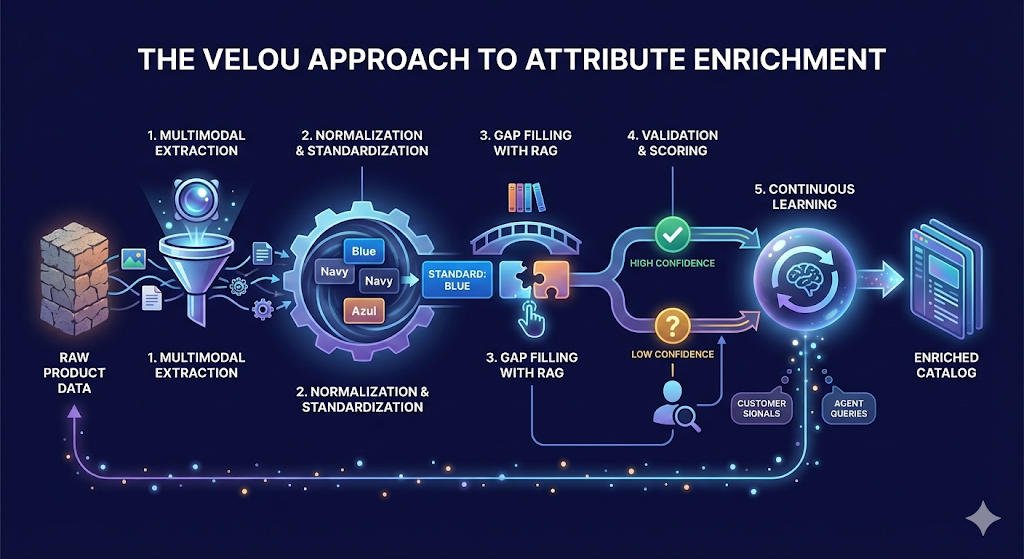
The Velou Approach to Attribute Enrichment
Velou uses AI-powered extraction combined with human-in-the-loop validation to enrich catalogs at scale.
Step 1: Multimodal extraction. Our models analyze product images, titles, descriptions, and specifications to extract structured attributes. Explicit attributes are identified directly. Implicit attributes are inferred from context and visual cues.
Step 2: Normalization and standardization. We map extracted values to industry taxonomies like Google's product taxonomy or category-specific standards. Inconsistent values get unified: "Blue," "Navy," "Azul" all map to standardized color: blue.
Step 3: Gap filling with RAG. For missing attributes, we use retrieval-augmented generation to infer likely values based on similar products and category norms.
Step 4: Validation and scoring. Each attribute gets a confidence score. High-confidence extractions publish immediately. Low-confidence attributes get human review.
Step 5: Continuous learning. As agents query your catalog and customers interact with products, we collect behavioral signals that refine attribute accuracy and completeness over time.
Business Outcomes: Visibility, Conversion, Lower Returns
Retailers with enriched product attributes see measurable improvements across key metrics.
3 to 5x higher visibility in AI recommendations. Products with complete attributes surface more frequently in agent-driven queries compared to incomplete listings.
10 to 25% CTR and conversion lift. Structured attributes enable better query matching, which drives higher click-through and purchase rates.
15 to 30% reduction in returns. Accurate attributes reduce purchase mismatches. Customers get products that match expectations, leading to fewer returns.
Higher AOV through better recommendations. Attribute-driven personalization surfaces complementary products and higher-value alternatives, increasing average order value.
Platform compliance and ranking boost. Amazon, Google Shopping, and other marketplaces prioritize products with complete, accurate attributes in their algorithms.
The Future of Attribute-Rich Catalogs
The next wave of commerce isn't just about having attributes. It's about having attributes that AI systems can reason over.
Advanced agents will query product relationships, compare attribute combinations, and recommend based on complex criteria: "Show me waterproof hiking boots under $150 available near me today with good reviews for wide feet."
That query requires attributes, inventory signals, location data, review sentiment, and real-time availability—all structured and accessible via API.
Velou is building toward this future by ensuring catalogs aren't just complete, but query-responsive and relationship-aware.
The retailers investing in attribute enrichment now are building the foundation for the next decade of AI-driven commerce. Those who wait will be stuck with catalogs that can't compete in agent recommendations, visual search, or voice commerce.

Start Enriching Your Attributes Today
Missing or inconsistent attributes aren't just a data quality issue. They're a revenue leak.
Velou transforms incomplete product catalogs into structured, attribute-rich datasets that power AI discovery, personalization, and conversion at scale.
Contact us to audit your catalog and build your attribute enrichment roadmap.

.png)
.png)