
How AI Shopping Assistants Choose What to Recommend (And Why It Matters)

You're Being Ranked. Do You Know the Rules?
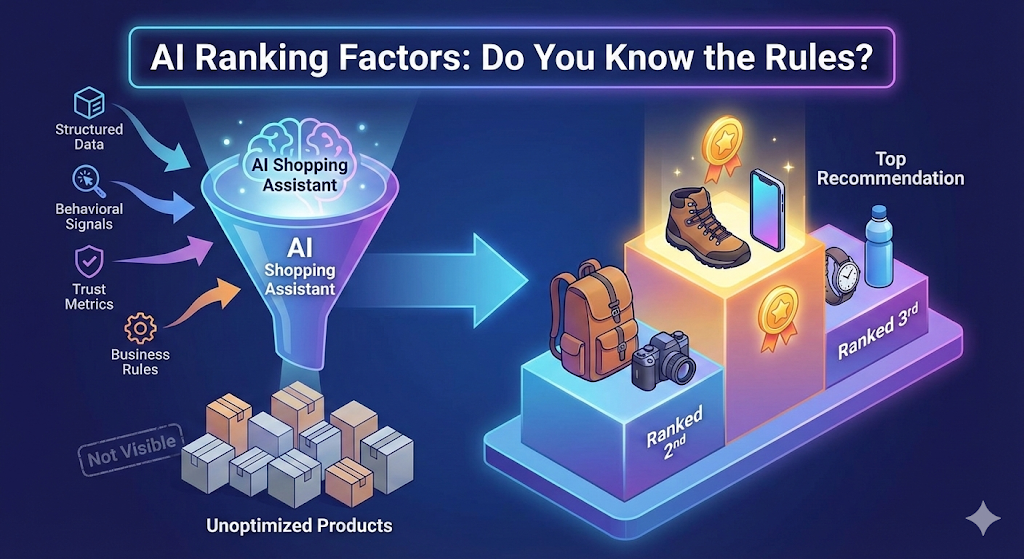
AI shopping assistants don't recommend products randomly. They rank on signals most retailers don't even know they're being judged on.
When someone asks ChatGPT, Rufus, or Perplexity to recommend hiking boots, the assistant doesn't browse your catalog like a human. It queries structured data, weights behavioral signals, evaluates trust metrics, and applies business rules—all in milliseconds.
If your product doesn't score well across these dimensions, it doesn't matter how good your marketing is. You're not in the consideration set.
The gap isn't that retailers lack good products. It's that they don't understand what AI systems optimize for when making recommendations.
The Ranking Signals That Matter
Behavioral signals carry 35 to 45% of the weight.
Click-through rate, conversion rate, add-to-cart activity, and engagement time are the strongest predictors of future performance.
If your product has high CTR and purchases for a specific query, it outranks competitors with better metadata but weaker engagement.
This creates a compounding effect: products that convert well get more visibility, which drives more conversions, which increases ranking further.
The problem: most retailers optimize for human browsers, not algorithmic signals. They focus on hero images and brand storytelling instead of the structured data that determines whether the AI even surfaces their product.
Data completeness matters more than most teams realize.
AI assistants prioritize listings with rich, parseable information: multiple high-quality images, schema.org markup, granular categories, detailed attribute data.
A hiking boot listing with terrain type, insulation specs, ankle height, and activity tags will outrank a listing labeled simply "boots" every time.
This isn't SEO. It's machine readability. If the AI can't confidently match your product to the query, it recommends something else.
Query relevance and session context add another 15 to 20%.
AI assistants interpret intent using semantic matching, location, device type, prior searches, and user preferences. They personalize results dynamically.
Winter boots for cold-weather users. Trail runners for hikers who searched "ultralight gear" last week.
Static product pages can't compete with systems that adapt to real-time context.
Price and offer signals account for 10 to 15%.
Not just sticker price—total value.
Competitive pricing aligned with market expectations, transparent shipping costs, clear return policies, and fulfillment options like FBA or WFS all factor in.
AI systems penalize pricing that's suspiciously low (quality risk) or significantly higher than alternatives (poor value). They reward transparency and frictionless buying.
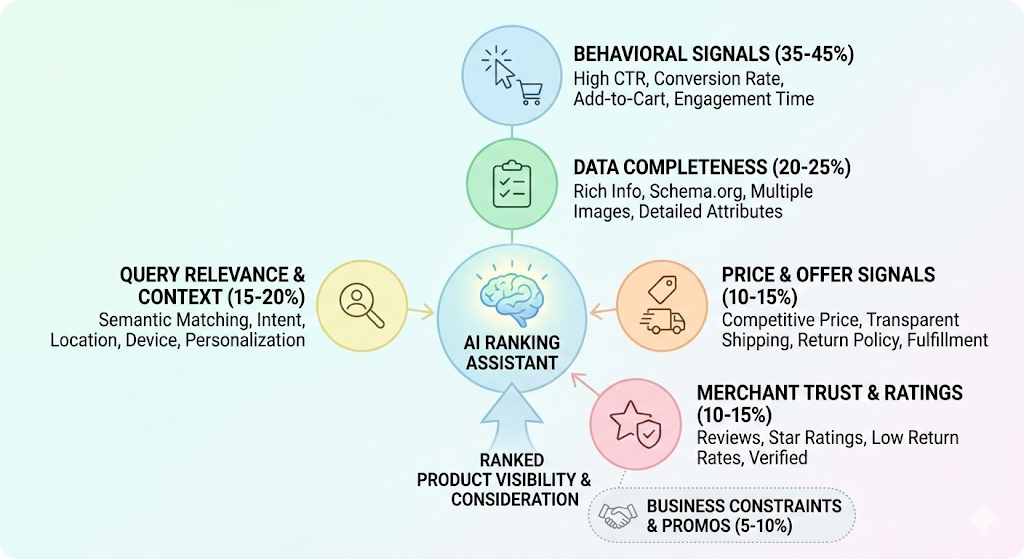
Merchant trust and ratings contribute 10 to 15%.
Customer reviews, star ratings, return rates, verified purchase badges.
High-rated products rank higher because they reduce buyer risk and increase satisfaction. AI assistants are risk-averse by design. They optimize for outcomes that don't generate negative feedback loops.
Business constraints and promotional rules take the remaining 5 to 10%.
Merchant agreements, affiliate incentives, preferred seller programs, and platform-specific promotional windows influence visibility.
This is the least transparent layer, but it's real. Platforms have commercial interests. Products that align with those interests get preferential treatment.
How to Surface Higher in AI Recommendations
Fix your product data.
Implement schema.org markup, add granular categories, include multiple images with unique alt text, write detailed feature bullets that match query language.
Drive sustainable engagement.
Run targeted campaigns to boost CTR and purchases, but optimize for real conversions, not vanity metrics. AI systems detect and penalize artificial inflation.
Compete on total value, not just price.
Use monitoring tools to maintain competitive pricing. Make shipping, returns, and fulfillment policies explicit and customer-friendly.
Build trust signals.
Collect verified purchase reviews aggressively. Display star ratings and sentiment aggregates prominently. Integrate third-party verification badges where possible.
Align with platform incentives.
Participate in preferred seller programs. Leverage promotional windows. Understand the platform's commercial priorities and structure offers accordingly.

The Uncomfortable Reality
Most retailers are invisible to AI assistants not because their products are inferior, but because their data infrastructure assumes human buyers.
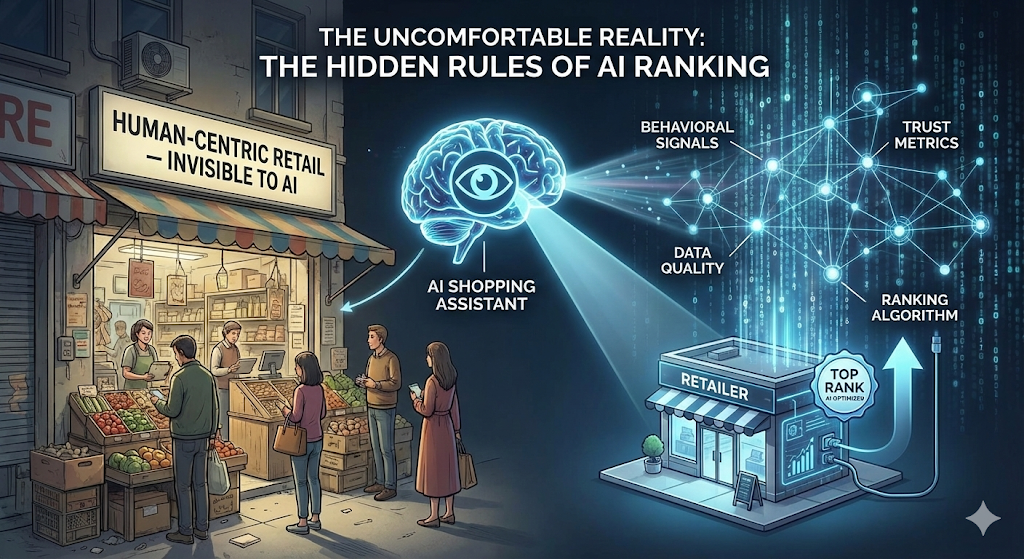
AI doesn't browse. It queries, ranks, and recommends based on signals that correlate with future satisfaction.
If your catalog isn't optimized for those signals, you're competing in a game where the rules changed and nobody told you.
Behavioral data compounds. Trust signals accumulate. Data quality creates momentum.
The retailers optimizing for AI ranking today will have structural advantages that are difficult to reverse in 18 months.
Your competitors are already doing this work. The question is whether you realize the game has changed.

.png)
.png)