
Geographic AI: How Location Context Will Reshape Local Commerce

The Most Underutilized Signal in Commerce
Location data is the most underutilized signal in commerce. And it's about to become the most valuable.
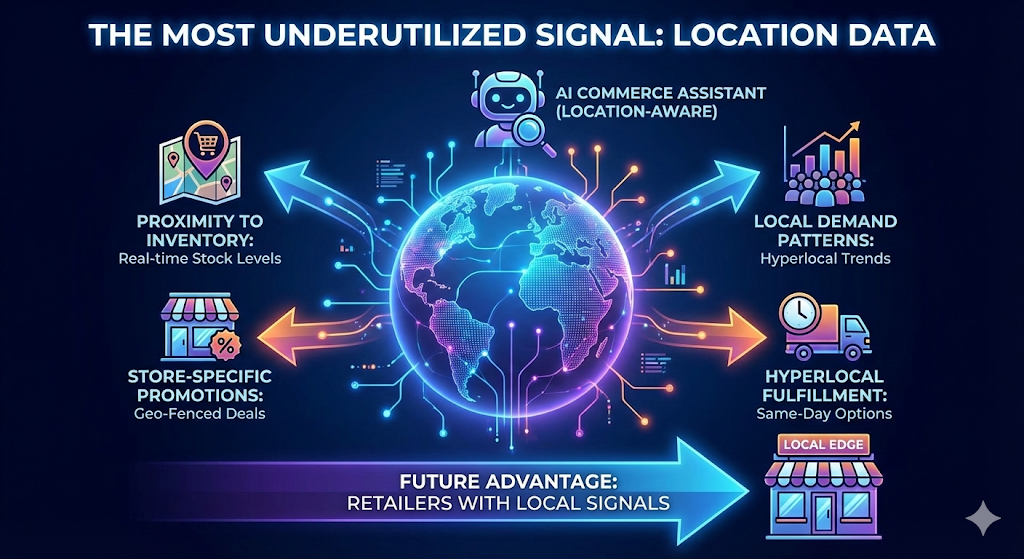
AI assistants can already recommend products based on purchase history, browsing behavior, and demographic patterns. What they can't do yet—but will soon—is layer real-time location context into every recommendation: proximity to inventory, local demand patterns, store-specific promotions, and hyperlocal fulfillment options.
When that capability matures, the retailers who control local inventory signals will have a structural advantage over national platforms that treat geography as an afterthought.
The Context Advantage
Starbucks proved this at scale. By combining geolocation with purchase history to trigger location-specific offers, they increased coupon redemptions and loyalty participation by 22%.
Not through better products or pricing. Through better context.
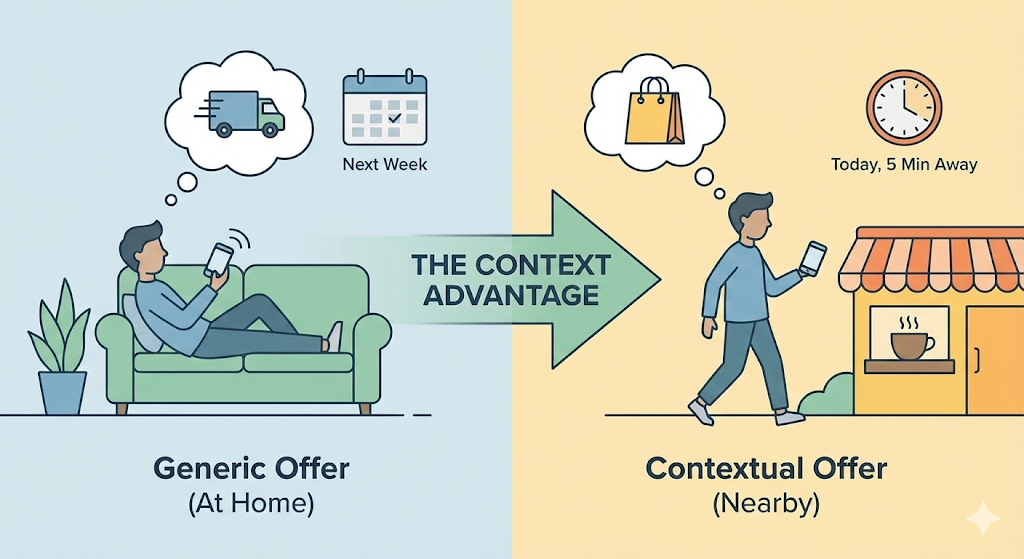
A promotion delivered when you're two blocks from a store converts at multiples of one delivered when you're at home.
Quick commerce players in grocery and pharmacy are already building for this. They sync local inventory in near-real-time, enabling AI assistants to recommend products available for same-day delivery or in-store pickup within minutes.
The conversion lift isn't marginal. It's existential. Customers choosing between two retailers will always pick the one that can fulfill today over the one promising delivery next week.
The Shift Most Retailers Are Missing
Location isn't just a filter. It's the organizing principle for the next generation of commerce infrastructure.
National e-commerce optimized for infinite selection and two-day shipping. Local AI commerce optimizes for immediacy and relevance.
"Show me running shoes" becomes "show me running shoes available at the store I'm walking past in my size."
The first query returns 10,000 results. The second returns three and converts at 10x the rate.
The Technical Requirements
Local commerce AI requires infrastructure most retailers haven't built yet.
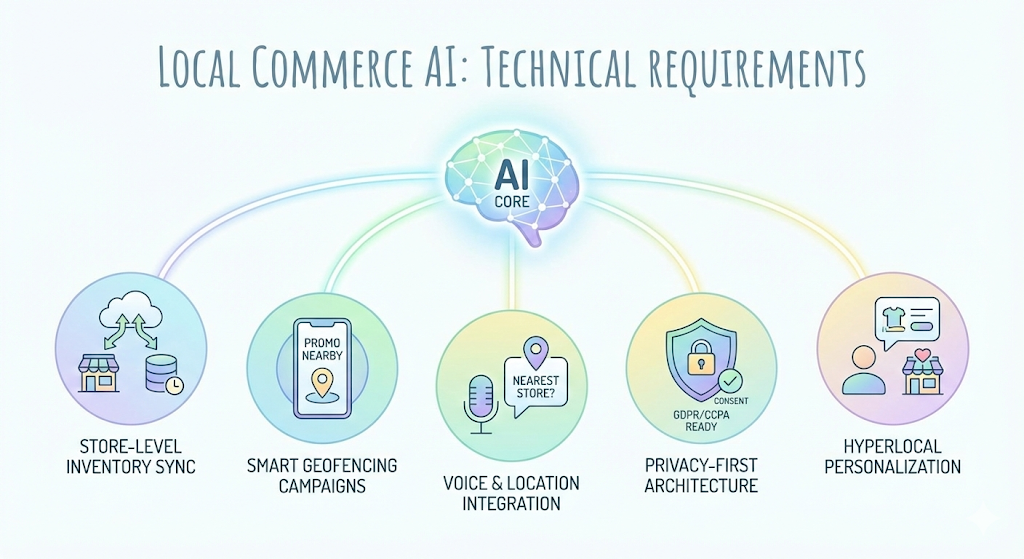
Store-level inventory sync.
Integrate with POS systems to provide real-time stock updates to AI platforms and local search engines. Stale data kills conversion. Accurate availability drives it.
Smart geofencing campaigns.
Deploy location-triggered notifications targeting walk-by traffic during peak hours or local events. A 15% off promotion delivered when someone is 200 meters from your store outperforms a 25% promotion delivered at random.
Voice and location integration.
Enable AI assistants to respond to queries like "nearest pharmacy with flu shots in stock" by combining voice input with real-time inventory and geolocation. This isn't futuristic. It's shipping now.
Privacy-first architecture.
Build explicit consent flows for location data, implement anonymization, ensure local data residency compliance with GDPR and CCPA. Consumers will trade location access for better service, but only if they trust the system.
Hyperlocal personalization.
Layer location with purchase history and local events to create "only-at-this-location" experiences. Not just "here's a discount" but "here's a product you bought before that's in stock now at the store you're approaching."
The Competitive Reality
National platforms like Amazon are already moving toward local. They're acquiring brick-and-mortar presence, building fulfillment density, and investing in same-day delivery infrastructure.
The advantage independent and regional retailers have today—physical proximity—will erode if they don't layer AI and inventory intelligence on top of it.
Multi-location restaurant chains using AI-powered location-specific content and listing management are seeing measurable improvements in local search ranking and conversions.
Quick commerce players syncing inventory APIs for ultra-fast delivery are capturing market share from slower competitors.
These aren't edge cases. They're the emerging standard.
Context-Aware vs. Context-Blind
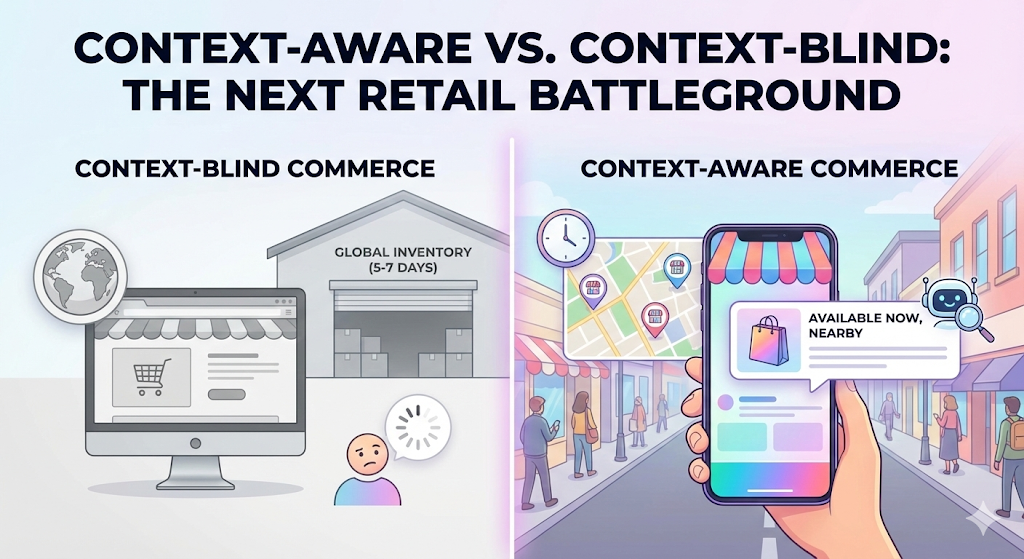
The next battleground in commerce isn't global vs. local. It's context-aware vs. context-blind.
AI assistants will recommend products based on what's available now, nearby, and relevant to the moment. Retailers who can't provide that signal won't be in the consideration set.
Your store location was always an asset. Soon it'll be your primary data advantage—if you build the infrastructure to surface it to AI systems in real time.
Stop treating inventory as a backend problem. It's the product discovery signal that determines whether you win the next decade of local commerce.

.png)
.png)