
Generative Enriched Outputs (GEO): Making Products Understandable to AI Assistants

Beyond Static Descriptions
Generative Enriched Outputs (GEO) represent a fundamental shift in how product data gets prepared for AI-driven commerce.
Traditional enrichment adds structured attributes to catalogs: size, color, material, price. GEO goes further, generating conversational, context-aware content that AI assistants can consume, reason over, and present to customers naturally.
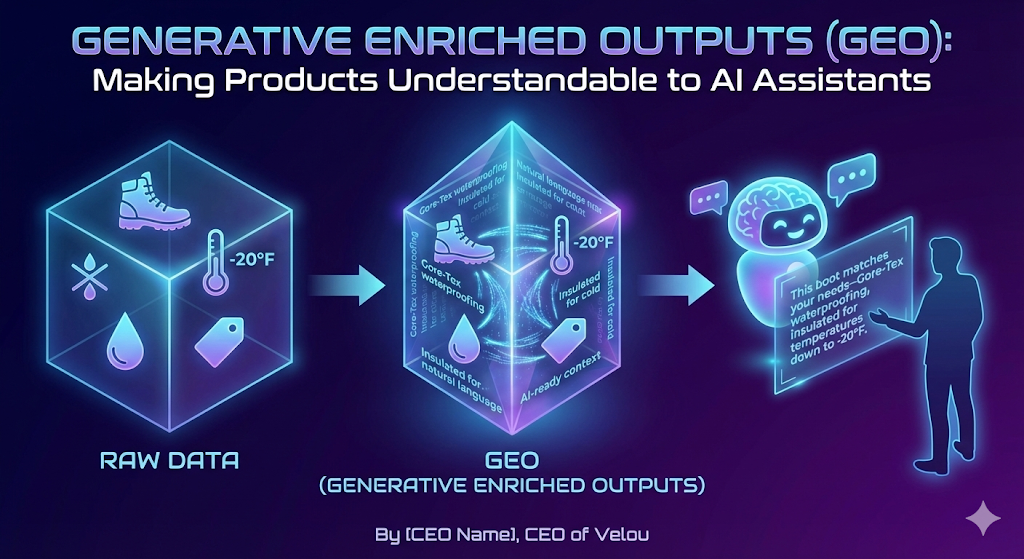
When someone asks ChatGPT or Rufus "show me waterproof hiking boots for cold weather," they don't want a data dump. They want a natural explanation: "This boot matches your needs—Gore-Tex waterproofing, insulated for temperatures down to -20°F, available in your size at the store near you, rated 4.8 stars from 500 verified purchases."
That response requires more than structured attributes. It requires generative outputs that combine product data, inventory context, reviews, and conversational framing into assistant-ready formats.
GEO is the infrastructure that makes products understandable to AI assistants at scale.
How LLMs Consume Product Data
AI shopping assistants process two types of product information differently.
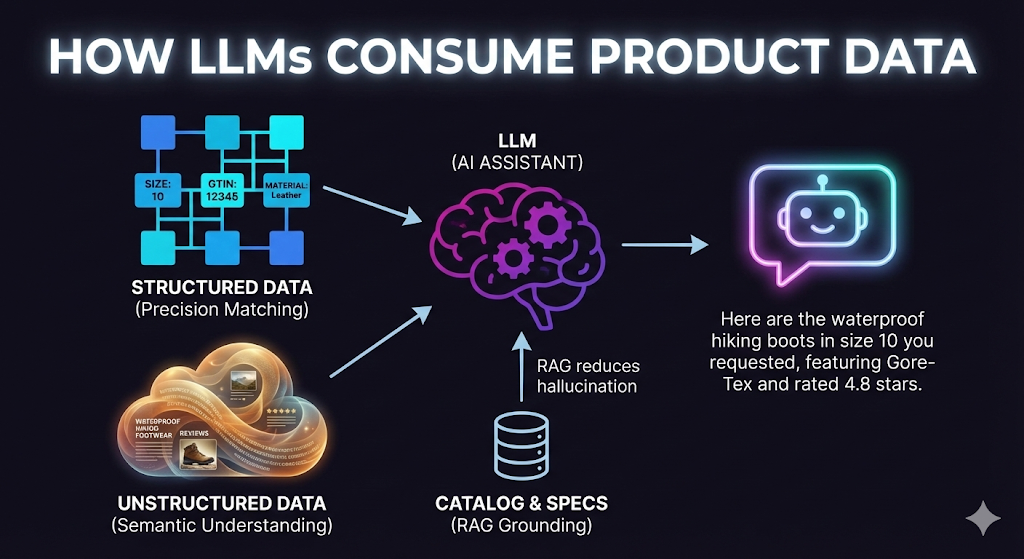
Structured data for precision matching.
JSON-LD, schema.org markup, and standardized attributes enable exact filtering and comparison. When an agent queries "waterproof boots size 10," it uses structured fields like water_resistance: waterproof and size: 10 for reliable matching.
LLMs prioritize verifiable attributes—GTIN codes, manufacturer specifications, dimensions—over vague marketing copy. "Premium quality materials" doesn't help matching. material_composition: leather, Gore-Tex lining does.
Unstructured text and images for semantic understanding.
Descriptions, reviews, and product images get processed via embeddings that capture semantic meaning. This enables fuzzy matching: "boots for wet trails" matches products described as "waterproof hiking footwear" even without exact keyword overlap.
The combination—structured precision plus semantic flexibility—is what makes modern AI assistants effective. They filter on hard attributes but explain and contextualize using natural language.
RAG for grounding and accuracy.
Pure generative models hallucinate product details. Retrieval-Augmented Generation solves this by retrieving relevant catalog information first, then generating responses grounded in that data.
When asked about a product's features, the agent retrieves the actual specification sheet, inventory status, and review highlights before generating its answer. This reduces hallucination rates by 60 to 80% while maintaining conversational fluency.
The GEO Framework: From Attributes to Conversations
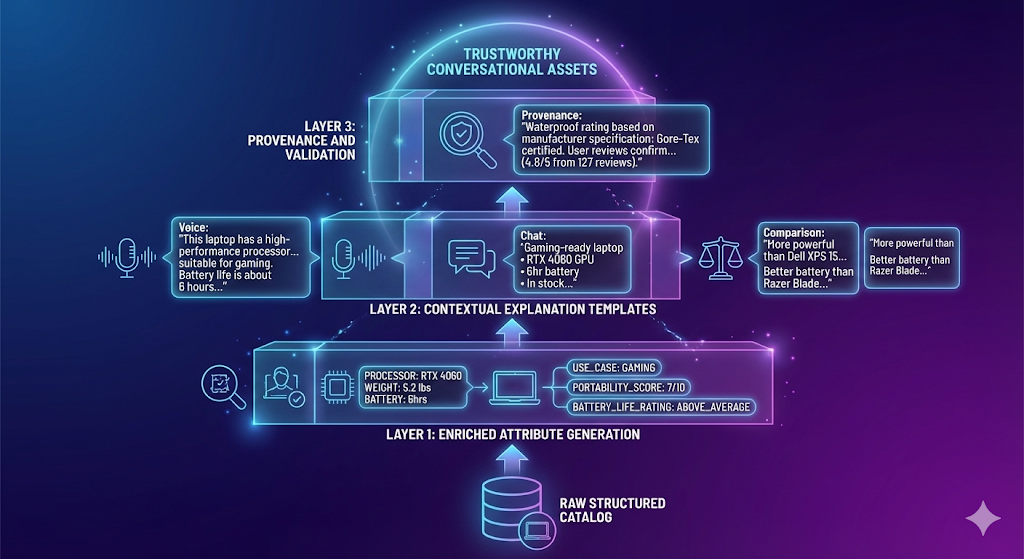
GEO transforms structured catalogs into conversational assets through three layers.
Layer 1: Enriched attribute generation.
Beyond basic extraction, GEO generates derived attributes that answer common questions. For a laptop, this includes use_case: gaming, portability_score: 7/10, and battery_life_rating: above_average.
These aren't in the raw specs. They're inferred from processor type, weight, battery capacity, and category norms—then expressed in language AI assistants can use naturally.
Layer 2: Contextual explanation templates.
GEO creates multiple explanation variants for the same product optimized for different contexts.
For voice: "This laptop has a high-performance processor and discrete graphics, making it suitable for gaming. Battery life is about 6 hours with moderate use."
For chat: "Gaming-ready laptop • RTX 4060 GPU • 6hr battery • Weighs 5.2 lbs • In stock for pickup today"
For comparison: "More powerful than the Dell XPS 15 but heavier. Better battery than the Razer Blade. $200 less than similar Alienware models."
Layer 3: Provenance and validation.
Every generated output includes source attribution. "Waterproof rating based on manufacturer specification: Gore-Tex certified. User reviews confirm performance in wet conditions (4.8/5 from 127 reviews mentioning 'waterproof')."
This ensures explainability for compliance and trust. Users can verify claims. Regulators can audit sources.
Conversational Commerce Patterns
GEO enables several high-converting interaction patterns.
Shoppable explanations.
Instead of listing products, agents explain why they match: "Based on your past purchases of trail running shoes and your location in Colorado, these boots suit mountain hiking—waterproof, ankle support, rated for rocky terrain."
This conversational context lifts conversion 20 to 30% over generic listings in early pilots.
Dynamic bundle creation.
GEO generates natural explanations for cross-product recommendations: "This tent pairs well with your sleeping bag—designed for the same temperature range, similar packed size, from the same brand family you've purchased before."
Objection handling.
When customers hesitate, agents use GEO to address concerns conversationally: "You mentioned price concerns. This model costs more upfront but includes a lifetime warranty and averages 8 years of use based on owner surveys, making cost-per-year lower than budget alternatives."
Voice-optimized snippets.
For voice assistants, GEO generates concise, speakable summaries: "Waterproof hiking boot, size 10, in stock locally for same-day pickup, rated excellent for cold weather, $179."
No extra words. No awkward phrasing. Just information optimized for spoken delivery.
Technical Implementation
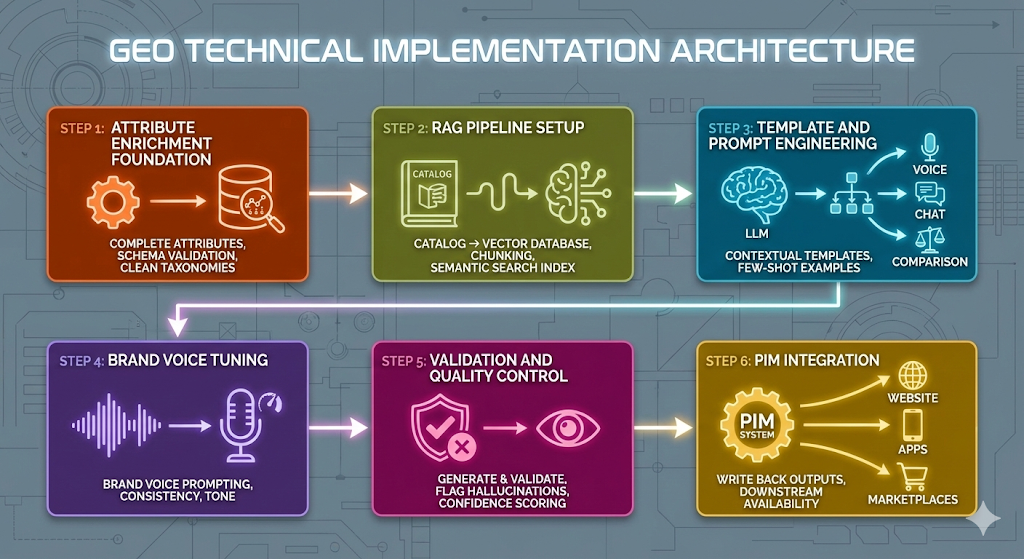
Production GEO systems follow a consistent architecture.
Step 1: Attribute enrichment foundation.
GEO builds on structured enrichment. You can't generate good conversational outputs from incomplete data. Start with complete attributes, schema validation, and clean taxonomies.
Step 2: RAG pipeline setup.
Connect your catalog to a vector database. Chunk products into retrievable segments: specifications, reviews, inventory, comparisons. Index with embeddings that enable semantic search.
Step 3: Template and prompt engineering.
Design generation templates for different contexts: voice, chat, comparison, bundle explanation, objection handling. Use few-shot examples to guide tone and format.
Step 4: Brand voice tuning.
Fine-tune or prompt-engineer models to match your brand voice. A luxury retailer sounds different from a value brand. GEO outputs should reflect positioning consistently.
Step 5: Validation and quality control.
Generate outputs, validate against source data, flag hallucinations or off-brand phrasing. Use confidence scoring to route low-quality outputs for human review.
Step 6: PIM integration.
Write GEO outputs back to your Product Information Management system alongside structured attributes. This makes them available to all downstream channels: website, apps, marketplaces, and AI platforms.
Real-World Performance
Early implementations show measurable impact.
Conversion lift: Products with GEO-enhanced descriptions convert 15 to 25% higher in AI assistant recommendations compared to raw attribute listings.
Reduced abandonment: Conversational explanations answer questions preemptively, reducing the need for customer service interactions and lowering cart abandonment.
Higher average order value: Dynamic bundle explanations drive cross-sell attachment rates up 20 to 35%.
Better review sentiment: When products are described accurately and contextually, purchase satisfaction increases, leading to better reviews and repeat purchase rates.
The Category Shift
GEO represents a new category in commerce infrastructure—sitting between traditional enrichment and customer-facing content generation.
It's not just about having complete product data. It's about having data that AI assistants can transform into helpful, contextual, brand-aligned conversations at scale.
As more discovery happens through conversational interfaces—voice assistants, chat agents, AI shopping tools—retailers without GEO infrastructure will struggle to compete. Their products will surface as data points, not stories. Specs without context. Attributes without explanation.
The retailers investing in GEO now are building the foundation for the next decade of AI-mediated commerce. Those who treat product content as static descriptions won't survive the transition to conversational shopping.

.png)
.png)